Florida Security Training Courses
State Courses


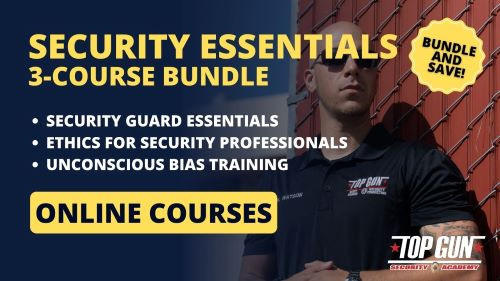
The Security Guard Essentials 3-Course Bundle combines our most popular courses and allows you to save $$! From mastering the essentials of working as a security guard, to honing ethical decision-making skills and addressing unconscious biases, this bundle equips you with the knowledge and expertise to excel in the world of security. And by purchasing these courses together, you can save 30% off of purchasing them separately!
Includes:
• Security Guard Essentials
• Ethics for Security Professionals
• Unconscious Bias Training
Price: $99.99
Unconscious bias refers to the attitudes or stereotypes that affect our understanding, actions, and decisions in an unconscious manner. These biases are often rooted in societal norms, personal experiences, and cultural influences. Our online course provides invaluable tools to recognize and address biases, empowering you to enhance your decision-making and ensure a safer environment for all.
Length: 2 Hours
Price: $39.95
Course Length – 2 hours
Price: $39.95
Prepare yourself or your team with the essential skills to navigate critical situations with confidence through our comprehensive Active Shooter Preparedness Training. In today’s unpredictable world, being prepared is not just a suggestion—it’s a necessity. Our expertly crafted program is designed to empower individuals and organizations with the knowledge and tools needed to respond effectively in the event of an active shooter scenario.
Top Gun provides 3 Active Shooter courses tailored to specific roles. This course is Active Shooter Preparedness Training for Employees and General Public.
Course Length – 1 hour
Price: $29.95
Prepare yourself or your team with the essential skills to navigate critical situations with confidence through our comprehensive Active Shooter Preparedness Training. In today’s unpredictable world, being prepared is not just a suggestion—it’s a necessity. Our expertly crafted program is designed to empower individuals and organizations with the knowledge and tools needed to respond effectively in the event of an active shooter scenario.
Top Gun provides 3 Active Shooter courses tailored to specific roles. This course is Active Shooter Preparedness Training for Unarmed Security Guards.
Course Length – 1.5 hours
Price: $34.95
Prepare yourself or your team with the essential skills to navigate critical situations with confidence through our comprehensive Active Shooter Preparedness Training. In today’s unpredictable world, being prepared is not just a suggestion—it’s a necessity. Our expertly crafted program is designed to empower individuals and organizations with the knowledge and tools needed to respond effectively in the event of an active shooter scenario.
Top Gun provides 3 Active Shooter courses tailored to specific roles. This course is Active Shooter Preparedness Training for Business Owners and Managers.
Course Length – 2 hours
Price: $39.95

If you want to work as a security guard in Florida, your first step is understanding the state's licensing process. Florida regulates private security work through the Florida Department of Agriculture and Consumer Services, commonly called FDACS, and the main credential for unarmed security officers is the Class "D" Security Officer License. Many people refer to this as a Florida guard card, although the official state term is a security officer license.
Top Gun Security Academy makes it easier to start building the knowledge and confidence you need for a security career. Our online security guard training options are designed for new officers, working guards, and employers who want practical, flexible training that supports professional growth. Students who want to explore additional options can also review Top Gun's full security training course catalog.
The Florida Security Guard Essentials Course introduces students to the day to day skills security officers use on the job, including observation, communication, professionalism, report writing, field notes, lawful conduct, emergency response, and conflict de-escalation.
Students should remember that Florida Class "D" licensing has its own state requirements. FDACS requires applicants to submit proof of at least 40 hours of professional training from a school or training facility licensed by the department, so students should always confirm that any licensing course they take satisfies the current Florida Class D requirement.
Security officers often make decisions under pressure, and those decisions can affect clients, visitors, employees, law enforcement, and the public. Ethics for Security Professionals helps students think through professionalism, honesty, communication, accountability, and the responsibility that comes with protecting people and property.
Unconscious Bias Training for Security Professionals helps guards recognize how assumptions can affect observation, judgment, and communication. That matters in Florida security work because guards may interact with residents, tourists, employees, contractors, students, patients, and event guests in fast moving situations where fairness and calm decision-making are essential.
Security officers are often expected to stay aware, respond calmly, and understand emergency procedures before a crisis occurs. Active Shooter Preparedness training helps students and professionals strengthen their emergency readiness, which can be valuable for schools, offices, churches, retail locations, event venues, and other public-facing properties.
Before applying for a Florida security guard license, applicants need to meet the state's basic eligibility rules. These requirements help Florida screen applicants before they work in private security roles where trust, judgment, and responsibility matter.
Florida Class "D" applicants generally must:
FDACS materials also note that applicants must provide information such as name, date of birth, Social Security number, criminal history disclosures, fingerprint submission, a personal inquiry waiver, and the appropriate fees. You can find more answers to common licensing questions on our FAQ page.
Florida's main unarmed security credential is the Class "D" Security Officer License. To apply, students must complete the required training, submit proof of training, complete the application, provide fingerprints, include required documentation, and pay state fees. The state licensing process is handled by FDACS, not by Top Gun Security Academy. Our guide to getting certified in your state walks through the process in more detail.
Florida requires proof of successful completion of at least 40 hours of professional training from a security officer school or training facility licensed by FDACS. The FDACS Security Officer Handbook also states that Class "D" licenses are valid for two years unless suspended or revoked, and license holders are responsible for renewing on time.
Once licensed, a Florida Class "D" security officer must have the license in their possession while on duty. Armed security work has additional requirements, including the Class "G" Statewide Firearm License, so students planning to work armed posts should review those rules separately before applying.
Florida offers many opportunities for trained security officers because the state has large metro areas, high tourism activity, major airports, hospitals, residential communities, shopping centers, ports, hotels, schools, event venues, and commercial properties. Security jobs may be available in cities such as Miami, Orlando, Tampa, Jacksonville, Fort Lauderdale, St. Petersburg, Naples, Sarasota, Tallahassee, and West Palm Beach.
Security guards in Florida may earn different wages depending on location, employer type, schedule, experience, and whether the position requires specialized duties. Metro areas such as Miami, Orlando, Tampa, Jacksonville, Fort Lauderdale, and Naples may all show different pay ranges, which is why students should compare local job postings before choosing a path. Our salary guide breaks this down in more detail.
Florida security officers may be hired by contract security companies, resorts, hospitals, apartment communities, schools, office buildings, logistics centers, event venues, retail stores, gated communities, construction sites, and government contractors. Some entry-level roles focus on access control and patrol, while more experienced officers may move into supervisor, site lead, dispatch, loss prevention, campus security, executive protection support, or armed security roles.
Top Gun Security Academy gives students a flexible way to build real security knowledge without rearranging their entire schedule. Our online courses are designed to be practical, accessible, and easy to follow, which helps new students stay focused while learning the fundamentals of professional security work.
Students choose Top Gun because our training is:
Not ready to enroll yet? Students can try the Free Demo Course and see how Top Gun's online training works before purchasing.
Top Gun Security Academy also offers a hub of state-specific training options for students across the country. Students can view Top Gun's 20+ state security training courses to find the right course for their location.
How long does it take to get a guard card in Florida?
Florida requires Class "D" applicants to complete at least 40 hours of professional training through a licensed security officer school or training facility before applying. The total time to receive your Florida security guard license can vary based on course scheduling, fingerprint processing, application accuracy, state review times, and whether FDACS needs additional information.
Can I complete security training fully online in Florida?
Some security training can be completed online, and Top Gun Security Academy offers online courses that help students build security knowledge and professional skills. However, because Florida requires Class "D" applicants to complete training through a department-licensed school or training facility, students should verify that any course used for licensing meets current FDACS requirements before relying on it for a license application.
What's the cost of guard card training in Florida?
Costs can include training tuition, state application fees, fingerprinting, photos, and other processing expenses. State licensing costs and third-party fingerprinting fees are separate from course tuition. Students should confirm current pricing before enrolling or applying.
How often do I need to renew my Florida security certification?
Florida Class "D" Security Officer Licenses are generally valid for two years unless suspended or revoked, and FDACS recommends renewing before expiration. The license holder is responsible for renewing on time, even if a renewal notice is missed.
Is a Florida guard card the same as a Class "D" Security Officer License?
In everyday searches, many people say "Florida guard card," but the official state credential for unarmed private security work is the Class "D" Security Officer License. Using both terms can be helpful when researching requirements, but students should follow FDACS terminology when completing official applications.